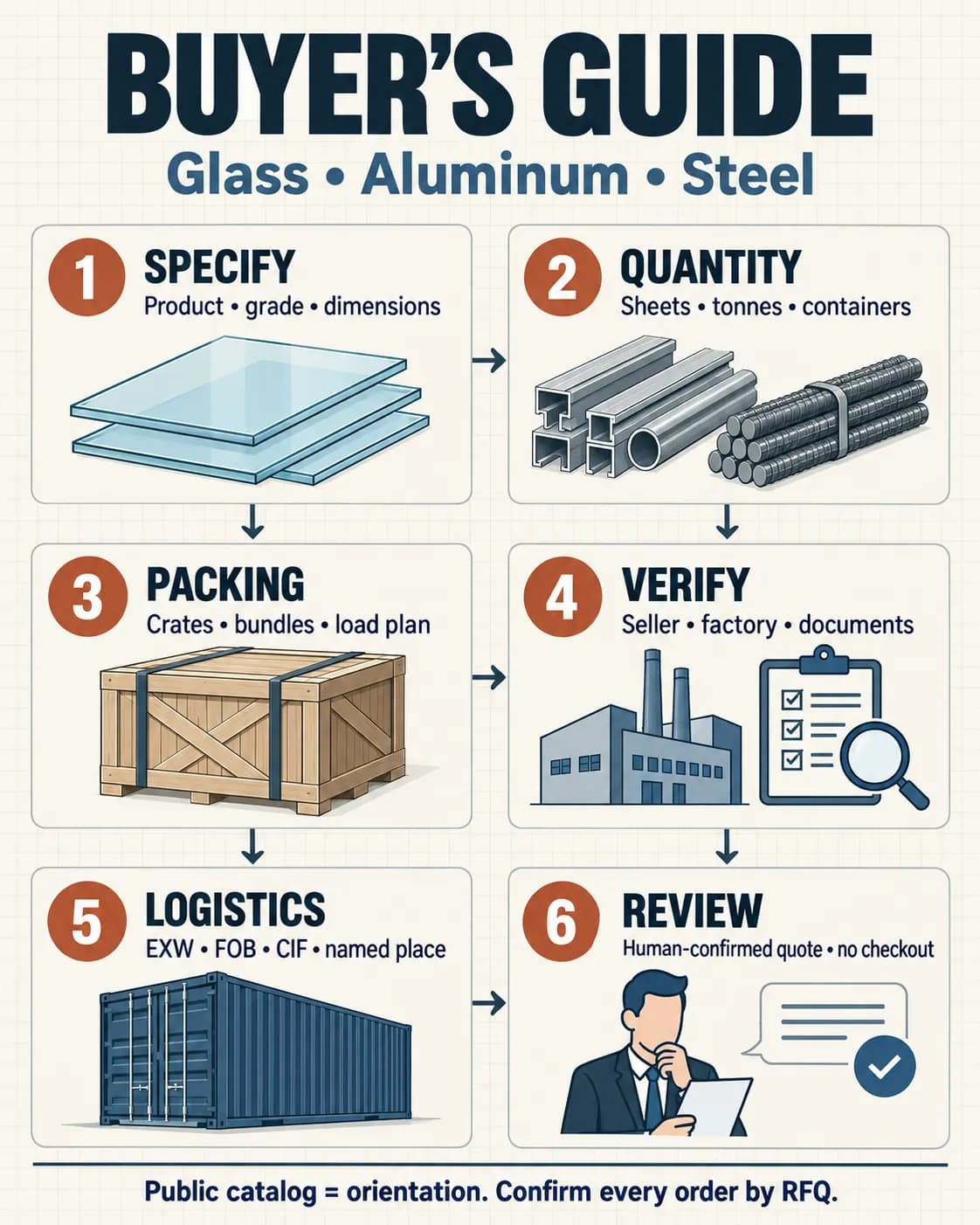
A practical checklist for importers and distributors evaluating Iranian industrial suppliers, comparing quotations, and preparing container-scale orders.
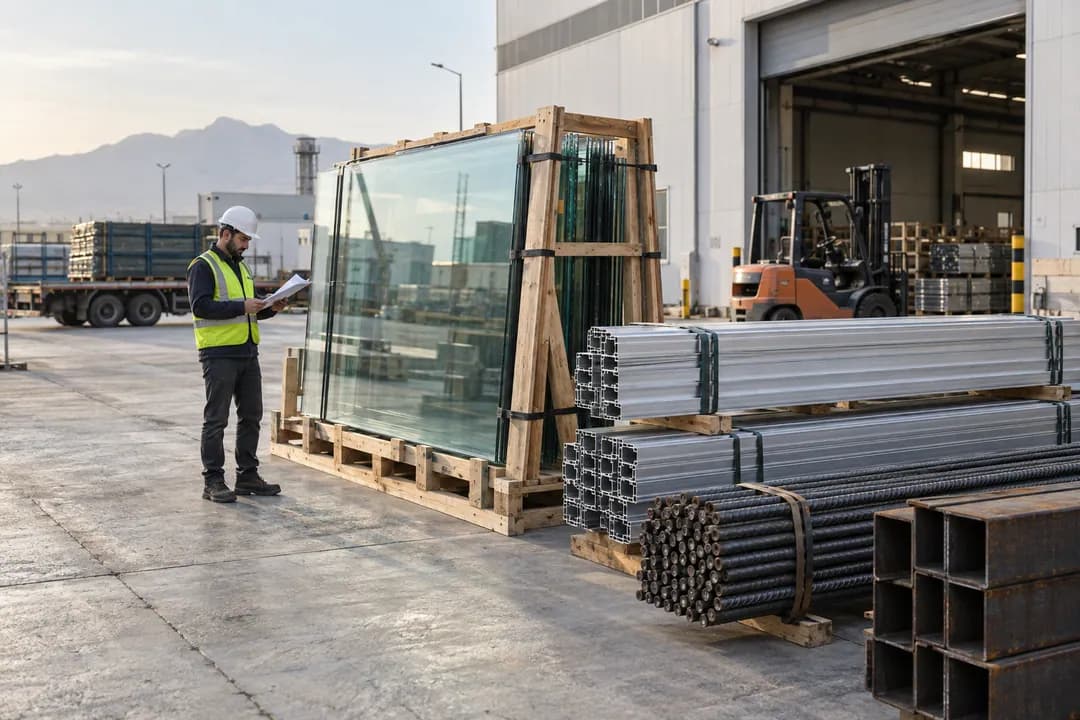
Related material plate: provisional reference only · Use the product schedule and confirmed RFQ for specifications
This guide is for professional buyers who need structured technical and commercial information before requesting a quotation. Source From Iran is a B2B catalog with human RFQ follow-up—not a marketplace checkout or automatic purchasing system.
1. Define a quote-ready specification
A product name alone is rarely enough. Provide the technical details that affect availability, production, packing, weight, and price.
Glass
State product type: float, patterned, reflective, mirror, laminated, tempered, ultra-clear, or solar glass. Thickness and exact sheet dimensions in millimetres. Color, tint, pattern, coating, or mirror backing. For laminated glass: glass build, interlayer type and thickness, and whether the plies must be tempered. Required edgework, polishing, beveling, holes, cut-outs, or other processing. Intended application and any project-specific performance requirements. For example, “5+5 laminated glass” is incomplete if the interlayer, dimensions, tempering, edge finish, and quantity are not stated.
Aluminum
State system type: sliding, folding, door and window, curtain wall, or another project system. Whether you need profiles only, profiles with fittings, or a complete fabricated system. Profile drawings, section codes, cutting list, or bill of quantities. Alloy and temper when specified by the project. Finish: mill finish, powder-coated, anodized, or another treatment. Color, coating thickness, thermal-break requirement, profile lengths, fittings, and whether glass is included. Aluminum quotations are generally project- and profile-schedule-based. Drawings are more reliable than product photos for establishing scope.
Steel
State product form: deformed rebar, wire rod coil, Z-profile, or another steel section. Diameter, section dimensions, length, coil or bundle requirements, and total tonnage. Required grade and governing standard. Required tolerances, test documentation, tagging, and heat or lot traceability. Do not infer a steel grade, standard, or mill identity from a provisional material image. Confirm these points in the written RFQ and supporting documents.
2. Match the quantity to the actual loading unit
Many public glass schedules currently show a minimum order of one 20ft container and an indicative production lead time of approximately 7–15 days. These are catalog references—not universal promises. The final load depends on glass thickness and sheet dimensions; packing method; sheets per crate or rack; container or truck weight limits; whether different products can be combined safely; current stock, production-line schedule, and color campaign. Mixed containers should be treated as possible only after written confirmation of the loading plan. Aluminum normally follows a project or profile schedule. Steel follows the applicable mill, coil, bundle, or length schedule. On the RFQ, separate your initial order from any expected monthly requirement; they are not the same commercial commitment. Also distinguish production lead time; packing and loading time; export and customs preparation; estimated transit time. Ask what event starts the lead-time clock—for example, order confirmation, deposit, drawing approval, or final specification approval.
3. Approve the packing and load plan
“Export packing” or “wooden crates” is not a complete packing specification. Before confirming an order, request a written packing plan covering packing type (wooden crates, stillages, racks, bulk packing, bundles, or coils); upright or horizontal loading orientation; edge protection, separators, bracing, and dunnage; sheets, profiles, bundles, or coils per package; number of packages per container or truck; net weight, gross weight, and estimated CBM; expected total loaded weight; package dimensions and handling requirements; photos or a drawing of the proposed packing method. For glass, uneven crate loading, insufficient support, exposed edges, and excessive weight can increase breakage risk. Confirm the number of sheets per crate and the final arrangement—not only the number of crates. For aluminum, confirm profile lengths, protective film, bundle construction, and how fittings will be packed. For steel, confirm bundle or coil weights, tags, lifting points, and the intended transport mode.
4. Build a structured multi-product RFQ
Create a separate RFQ line for every distinct product or specification. Each line should include product and category; technical specification; dimensions or profile reference; grade or standard where applicable; quantity and unit of measure; preferred packing; required documentation; inspection requirement; technical notes or attached drawings.
At RFQ level, also provide:
- Destination country, port, border point, or final delivery location.
- Preferred Incoterm: EXW, FOB, CIF, or another requested basis.
- Named place or port—not only the Incoterm abbreviation.
- Preferred transport mode, if known.
- Required readiness date.
- Currency and quotation-validity requirement.
- Whether the order is a trial, one-time purchase, or recurring program.
A useful RFQ line format is: Product · specification · dimensions · quantity · packing · destination · Incoterm · required documents. No account or online payment is required to submit a requisition. A human reviews the RFQ and follows up on missing information.
5. Separate product pricing from logistics
A product price and a delivered price answer different questions. EXW: ask for the exact factory or loading point and what loading services are included. FOB: confirm the named port, origin charges, loading responsibility, and what is included before the goods are placed on board. CIF: confirm the destination port, freight amount, insurance scope, routing, and exclusions. For every logistics quotation, clarify origin and destination points; container, truck, rail, or other transport mode; load port or border crossing; expected route; included origin charges; excluded destination charges; customs-clearance responsibility; freight quotation validity; whether transit time is an estimate or a carrier-confirmed schedule. Freight and routing can change independently of the product price. Public pages therefore do not guarantee transit time or landed cost.
6. Verify the supplier and document path
Before a deposit or large order, confirm legal name of the contracting seller; name and address of the actual manufacturer; exporter of record where different; physical production or loading location; whether the quoted factory can make the exact specification and quantity; whether the seller, invoice issuer, and payment beneficiary are consistent and documented; whether independent pre-shipment inspection is available by agreement. Ask which documents can be supplied for the specific order. Depending on the product and destination, these may include commercial invoice; packing list; certificate of origin; mill test certificate, test report, COA, or technical data sheet; product or quality certificate required by the destination market; weight list and package schedule; HS-code guidance; inspection report. Do not assume that a certificate shown for another factory, market, product, or shipment applies to your order. Destination-specific requirements must be checked with your customs broker, bank, insurer, and relevant authorities before payment. Buyers should also complete their own import-eligibility, trade-control, banking, insurance, customs, and standards checks for the destination country.
7. Treat catalog figures as orientation
Product schedules may show indicative price bands, minimum orders, technical fields, or historical capacity notes. Use them to prepare an RFQ—not as a binding offer. Current pricing can depend on exact specification and dimensions; order quantity and load efficiency; raw-material or LME basis; current factory or mill schedule; packing requirements; inspection and documentation; transport route and quotation date. Source From Iran does not publish invented certificates, customer lists, shipment volumes, or guaranteed capacity. Ask for evidence that is relevant to your product, factory, and order.
8. Review the quotation or pro forma carefully
Before approving the commercial document, check that it states exact product specification and quantity; unit price, total price, currency, and pricing unit; Incoterm and named place or port; packing method and expected load plan; gross and net weight where available; payment terms and quotation validity; production-readiness estimate; required documents and inspection arrangements; contracting seller and payment-beneficiary details; treatment of substitutions, shortages, excess weight, or specification changes. Resolve inconsistencies before payment. A chat message, catalog image, or provisional material plate should not override the confirmed quotation, pro forma, or final contract.
9. What happens after submission
The requisition enters a human review queue. The team checks the RFQ for completeness, separates product and logistics questions, and matches each line to current factory or mill capability. Follow-up may be required to confirm dimensions, grades, colors, or drawings; whether requested items can share a load; packing and maximum load weight; current production availability; documentation and inspection requirements; available Incoterm and route; current commercial guidance. Submitting an RFQ does not place an order, reserve production capacity, or trigger payment. A quotation or pro forma is prepared only after the relevant technical and commercial details have been confirmed.
Catalog note: Public price bands, MOQs, and lead times are orientation data. Current FOB guidance and final order terms are confirmed through the RFQ process.