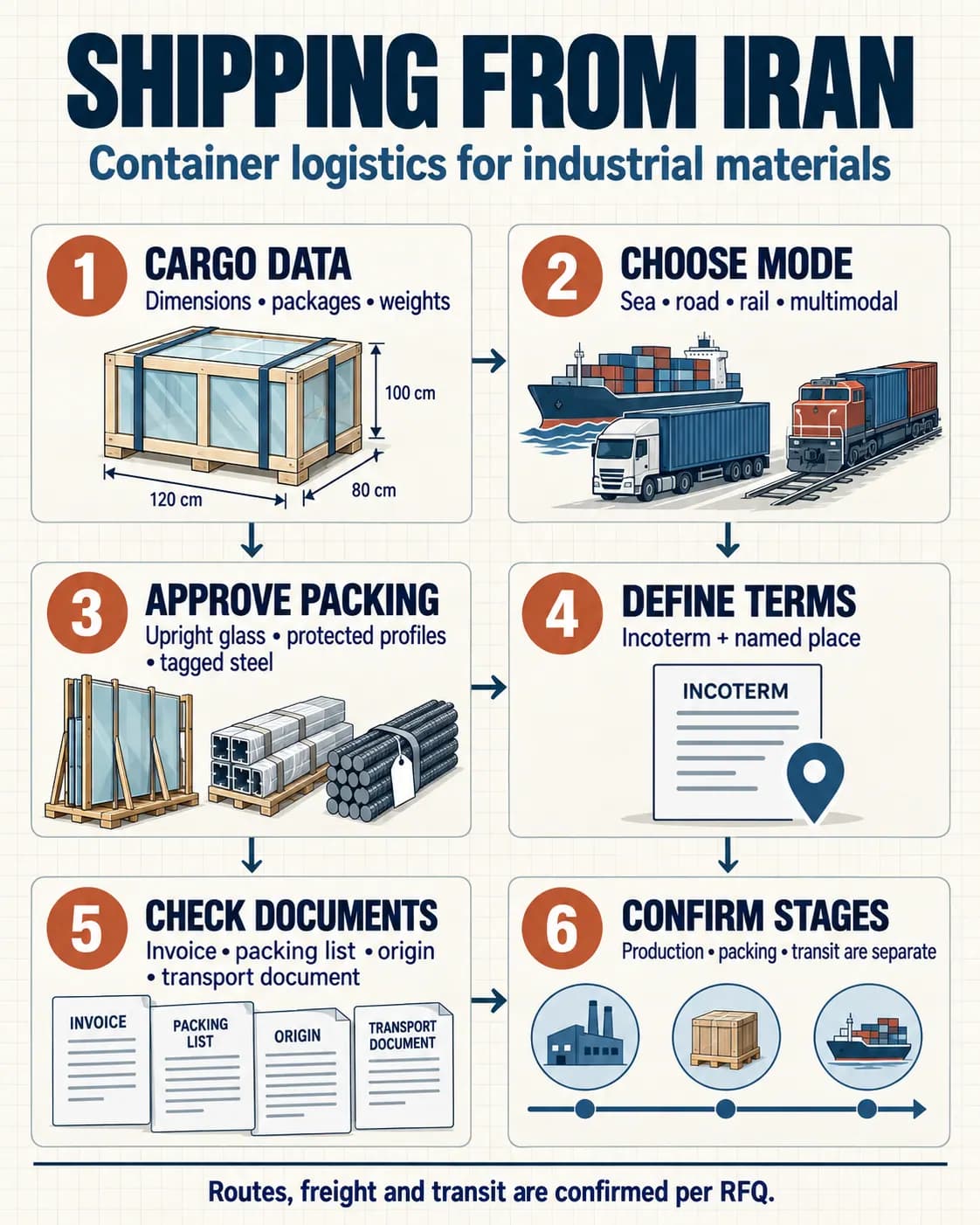

How to plan packing, loading, documentation, and transport for glass, aluminum, and steel sourced from Iranian manufacturers.
Export logistics cannot be separated from the product specification. Sheet dimensions affect glass packing; profile lengths affect the vehicle or container; steel tonnage affects payload and load distribution. Source From Iran therefore treats shipping as part of our team-reviewed RFQ process—not as an automatic freight calculator or guaranteed public schedule.
1. Prepare the cargo data before requesting freight
A forwarder cannot produce a reliable quotation from the product name and destination alone.
For each RFQ line, provide:
- Product and material type.
- Exact dimensions, thickness, diameter, or profile length.
- Order quantity and unit of measure.
- Estimated net product weight.
- Number and type of packages.
- Package dimensions and estimated gross weight.
- Required loading orientation.
- Whether the cargo is fragile, non-stackable, or requires special handling.
- Expected production-readiness date.
- Factory or collection location, if already confirmed.
- Destination port, border point, or final delivery address.
If final package data is not yet available, label the freight quotation as provisional. Recalculate it after the supplier issues the packing list and final load plan.
2. Choose the transport mode around the cargo
Iranian industrial materials may move by sea, road, rail, or a combination of modes. The practical route depends on the destination, cargo dimensions, payload, packing method, border conditions, and available carriers.
Sea freight
Container shipping may be suitable for glass, aluminum profiles, and container-compatible steel products.
Confirm:
- 20ft or 40ft container.
- Container payload and internal dimensions.
- Full-container or other agreed shipping arrangement.
- Port of loading and discharge port.
- Carrier routing and any transshipment.
- Container condition requirements.
- Terminal, documentation, and origin charges.
- Destination charges and customs responsibility.
- Estimated sailing schedule and freight validity.
Many glass schedules on this site use one 20ft container as the reference MOQ. This does not mean every glass specification fits the same number of sheets or crates. Thickness, sheet size, packing, and legal payload determine the final quantity.
Road transport
Road transport can support regional and overland deliveries using trucks, trailers, or other suitable vehicles.
Before dispatch, confirm:
- Exact loading and delivery points.
- Vehicle type and legal payload.
- Route and border crossing.
- Whether the same vehicle travels to destination or the cargo will be transferred.
- Transit permits and customs responsibilities.
- Driver acceptance of the planned cargo weight.
- How the load will be secured and protected in transit.
Direct road transport may reduce handling, but route availability, cost, and timing must be confirmed for each shipment.
Rail and multimodal routes
Rail or combined road–rail–sea routes may be considered where commercially and operationally available.
Ask:
- Where each transfer takes place.
- How many times the cargo will be unloaded or repositioned.
- Who is responsible at each transfer point.
- Whether the packing is suitable for repeated handling.
- Whether the quoted transit time includes waiting for departure, border processing, and interchange.
- Which transport document applies to each leg.
For fragile cargo, every additional handling point should be reflected in the packing and inspection plan.
Breakbulk or project cargo
Heavy steel orders, oversized profiles, and project cargo may require alternatives to a standard container. Availability is confirmed by shipment—not assumed from the product page.
Provide dimensions, unit weights, lifting points, center-of-gravity information where relevant, and the complete project quantity before requesting this route.
3. Select packing for the transport mode
Packing must be designed for the actual journey, not only for movement inside the factory.
Glass
Common options may include export wooden crates, stillages or racks, and bulk arrangements approved for the chosen vehicle.
Confirm in writing:
- Whether the glass will remain upright.
- Sheets per crate, rack, or package.
- Number of packages per container or truck.
- Internal separators and surface protection.
- Edge and corner protection.
- Base support and load distribution.
- Bracing, blocking, and lashing.
- Whether the package can tolerate transshipment.
- Final net and gross weights.
- Photos or drawings of the proposed packing.
Do not approve a plan based only on the phrase “wooden packing.” Uneven sheet counts, loose packages, exposed edges, insufficient bracing, or excessive package weight can increase breakage risk.
If different glass types or thicknesses will share a load, request a line-by-line loading plan. Mixed loading is possible only when the factory and carrier confirm that the arrangement is safe and within payload limits.
Aluminum profiles and systems
Confirm:
- Maximum profile and package length.
- Profiles per bundle.
- Protective film or wrapping.
- Separation between finished surfaces.
- End protection.
- Bundle weight and lifting method.
- Packing for fittings, gaskets, and hardware.
- Whether fabricated frames or glass are included.
- Whether the cargo can be stacked.
Long profiles may affect the choice of container or vehicle even when the total weight is relatively low.
Steel
Confirm:
- Bundle or coil weight.
- Number of bundles or coils.
- Bar or section length.
- Package tags and product identification.
- Heat or lot references where required.
- Lifting and securing points.
- Rust or moisture protection required by the contract.
- Container-floor and axle-load distribution.
- Whether the order will move by container, trailer, rail, or breakbulk.
Do not use mill production capacity as the transport payload. The maximum permitted load is governed by the equipment, route, carrier, and applicable transport rules.
4. Request a line-by-line load plan
Before booking transport, the supplier should be able to provide or confirm:
- Package number.
- Package contents.
- Quantity per package.
- Package dimensions.
- Net weight.
- Gross weight.
- Total package count.
- Total load weight.
- Estimated CBM.
- Container or vehicle type.
- Loading orientation.
- Special handling marks.
For glass, also request the number of sheets in each package. For aluminum, request bundle lengths and fittings-package details. For steel, request bundle or coil weights and tags.
The load plan should agree with the commercial invoice, packing list, transport booking, and carrier payload.
5. Define the Incoterm and named place
An Incoterm without a named location is incomplete.
EXW
Confirm:
- Exact factory or collection address.
- Whether loading onto the buyer’s vehicle is included.
- When the cargo becomes available for pickup.
- Who prepares export documentation.
- Who completes export customs formalities.
FOB
Confirm:
- Named port of loading.
- Inland movement from factory to port.
- Export customs responsibility.
- Terminal and loading charges.
- Point at which the quoted responsibility ends.
- Documents included in the quotation.
CIF
Confirm:
- Named destination port.
- Freight amount and quotation validity.
- Insurance scope and insured value.
- Carrier and route when available.
- Transshipment, if any.
- Charges excluded at destination.
- Whether the quotation covers only the port or any onward delivery.
Product price, inland transport, ocean freight, insurance, and destination charges should be identifiable rather than hidden inside one unexplained total.
6. Treat freight prices as time-sensitive
Freight may change because of:
- Carrier capacity.
- Fuel and currency movement.
- Border or port conditions.
- Equipment availability.
- Route changes.
- Seasonal demand.
- Waiting time.
- Revised cargo weight or package count.
Every logistics quotation should state:
- Currency.
- Issue date.
- Validity period.
- Cargo assumptions.
- Included charges.
- Excluded charges.
- Estimated transit time.
- Free-time or waiting assumptions where applicable.
- Conditions that require requotation.
A freight figure prepared before final dimensions and weights is guidance—not a confirmed shipment cost.
7. Separate production readiness from transit time
“Delivery in 15 days” can be misleading unless the timeline is divided into stages.
Ask for separate estimates for:
- Technical confirmation and drawing approval.
- Production or stock allocation.
- Packing.
- Inspection.
- Final documentation.
- Vehicle or container positioning.
- Export customs and port or border processing.
- Main transit.
- Destination customs and collection.
Production lead time does not include transit unless the quotation explicitly says so. Likewise, a carrier’s transit estimate may begin only after departure—not when the order is placed. Public pages do not guarantee arrival dates. Current timing is confirmed after the specification, production slot, route, and carrier are known.
8. Confirm the shipment document set
Document requirements depend on the product, transport mode, destination, and commercial agreement. The shipment file may include:
- Commercial invoice.
- Packing list.
- Certificate of origin.
- Transport document, such as a bill of lading or road consignment document.
- Export declaration or related customs records.
- Weight list.
- Product test report, COA, TDS, or mill test certificate where applicable.
- Inspection report.
- Insurance document where included.
- Product-specific certificates required by the destination market.
Before loading, check that the documents agree on:
- Seller and buyer names.
- Shipper and consignee.
- Product description.
- Quantity and unit.
- Package count.
- Net and gross weight.
- Country of origin.
- Marks and package references.
- Port or border information.
- Invoice and order references.
Also confirm whether originals must travel with the driver or cargo, be couriered separately, or can be accepted electronically. Late or inconsistent documents can delay customs processing even when the cargo is ready. HS-code information supplied by a seller should be treated as guidance. The importer and customs broker should confirm the final classification for the destination country and intended use.
9. Inspect before sealing or dispatch
Where appropriate, agree on inspection before loading. Inspection may cover:
- Product type and dimensions.
- Visible quality and finish.
- Quantity.
- Package construction.
- Package markings.
- Sheets, profiles, bundles, or coils per package.
- Weight records.
- Container or vehicle condition.
- Bracing and lashing.
- Seal number.
- Loading photos or video.
- Required test or mill documents.
Define the acceptance criteria before production or packing. A video taken after loading cannot replace an agreed specification or correct an unsuitable packing plan. Independent inspection may be requested by agreement. Its scope, timing, cost, and reporting format should be included in the RFQ.
10. Complete destination and compliance checks
Before payment or dispatch, the buyer should confirm with its bank, customs broker, insurer, forwarder, and relevant authorities whether the product can be imported into the destination market, applicable trade-control or sanctions requirements, required product standards or destination certificates, banking and payment-route eligibility, customs duties, taxes, and import permits, insurance availability, acceptable carrier and routing, and document legalization or original-document requirements.
A certificate available for one country or factory does not automatically apply to another market, product, or shipment.
11. What to include in a shipping-ready RFQ
To receive useful logistics guidance, include:
- Product lines and complete technical specifications.
- Exact quantities.
- Package preference.
- Estimated or required load count.
- Destination port, border, or address.
- Preferred Incoterm and named place.
- Preferred transport mode.
- Required readiness date.
- Required documents.
- Inspection requirement.
- Any maximum weight, length, or handling restrictions.
A strong request might read: Clear float glass · 6mm · confirmed sheet size · one 20ft container · export wooden crates · upright loading · CIF named destination port · packing list, certificate of origin, and pre-loading photos required.
12. What happens after submission
Once submitted, your RFQ is reviewed by our team. The team checks the product lines, quantity, packing request, destination, and Incoterm before seeking current factory and logistics confirmation.
Follow-up may be needed to:
- Finalize dimensions or profile lengths.
- Confirm package construction.
- Calculate the load.
- Match the order to current production capacity.
- Identify a workable transport mode.
- Obtain a current freight quotation.
- Confirm required documents.
- Resolve destination or carrier restrictions.
Submitting an RFQ does not book transport, reserve a container, confirm a route, or guarantee a departure date. Those steps occur only after the cargo specification, commercial terms, packing plan, and current logistics availability have been confirmed.
Logistics note: Public pages describe the process and common shipping patterns. Final packing, payload, route, freight, insurance, documentation, and transit guidance are confirmed for each RFQ.