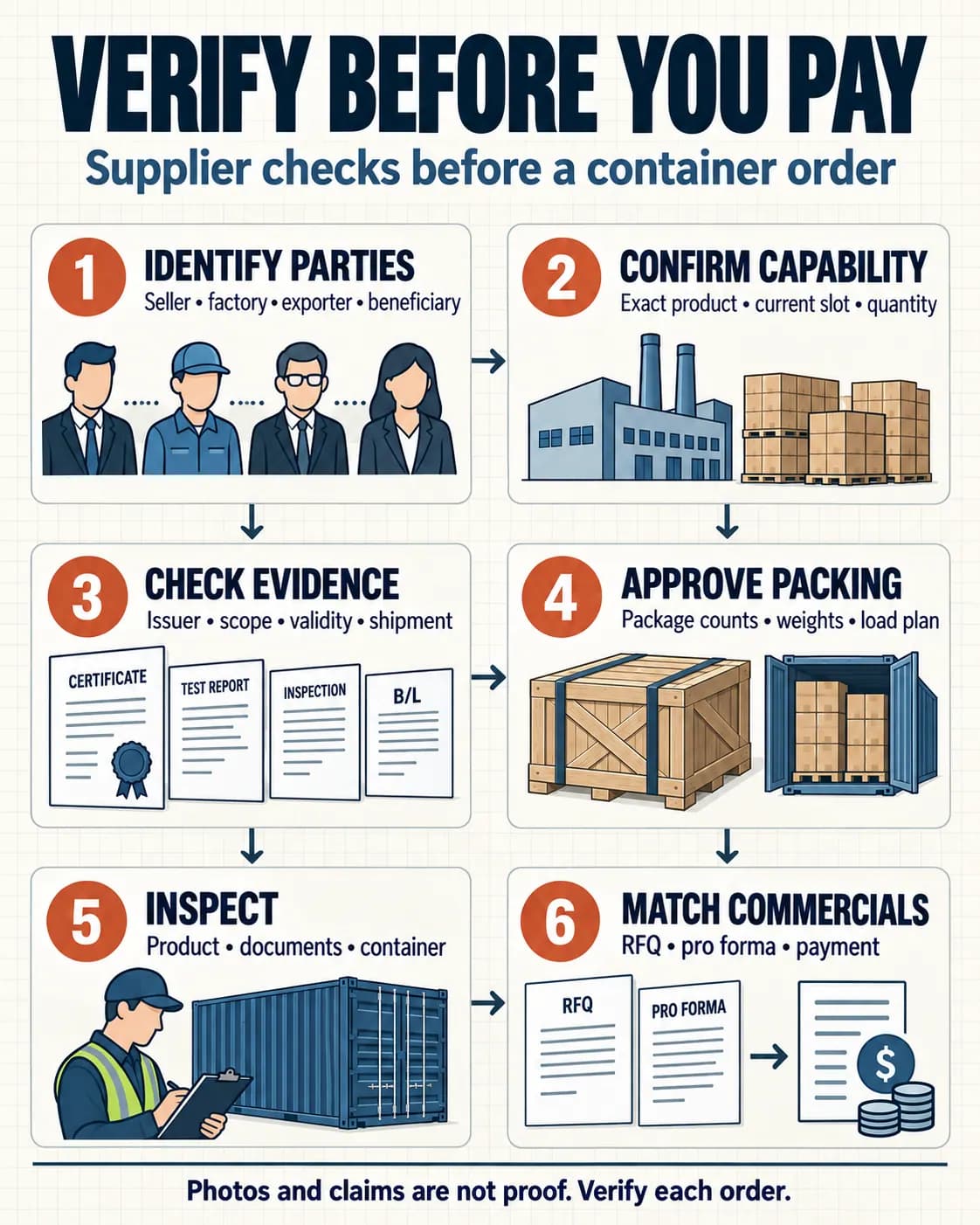

Practical checks importers can run before committing to an Iranian industrial supplier—without relying on unverified claims, catalog images, or informal assurances.
Source From Iran does not publish invented certificates, customer lists, production volumes, or shipment claims. Verification remains the buyer’s responsibility. We support that process with clear product pages, contact information, and personal RFQ follow-up. A supplier should be verified for the specific product, factory, order, destination, and commercial arrangement—not treated as universally verified because one document or previous shipment exists.
1. Identify every party in the transaction
The brand, sales team, manufacturer, exporter, invoice issuer, and payment beneficiary may not always be the same entity. That is not automatically a problem, but the relationship must be clear and documented.
Confirm:
- Legal name of the contracting seller.
- Registered and physical business addresses.
- Company registration and tax information where applicable.
- Name and location of the actual manufacturer.
- Whether the contact is an employee, sales team, representative, broker, or independent trader.
- Exporter of record.
- Entity issuing the quotation and pro forma.
- Authorized signatory.
- Payment beneficiary and its relationship to the seller.
- Factory or warehouse loading address.
Ask the supplier to explain any difference between these parties in writing. An unexplained third-party invoice or payment instruction should be resolved before funds are transferred. If bank or beneficiary details change, verify the change through a previously established contact channel. Do not rely only on a new message, forwarded document, or unfamiliar email address.
2. Confirm the physical operation
A company profile, catalog, or website is not proof that a supplier controls the stated factory or stock.
Depending on the size and risk of the order, request:
- Current factory and warehouse addresses.
- A scheduled video call from the facility.
- Dated production, stock, and loading-area images.
- Factory signage or other location evidence.
- A factory visit by the buyer or an appointed inspector.
- Confirmation that the facility can produce or process the exact RFQ lines.
- The proposed loading point for the order.
A visit should verify the relevant production or packing operation—not only an office or sample room. Where a supplier sources different products from different factories, identify the factory responsible for each RFQ line. Packing standards, lead times, quality controls, and documents may differ between facilities.
3. Verify capability line by line
Do not accept a general statement such as “we produce all types” as confirmation of a specific order.
Glass
- Glass type, thickness, color, coating, pattern, and dimensions.
- Current stock or required production run.
- Laminated build and interlayer specification.
- Tempered or non-tempered construction.
- Edge finishing, holes, cut-outs, or other processing.
- Quality criteria and permitted defects.
- Packing method and sheets per package.
- Whether every requested line comes from the same factory.
Aluminum
- System type and profile references.
- Profiles only, profiles with fittings, or finished units.
- Alloy and temper where required.
- Mill, anodized, powder-coated, or other finish.
- Color and coating requirements.
- Thermal-break construction.
- Profile lengths, bundle plan, and protective film.
- Ability to work from the supplied drawings and bill of quantities.
Steel
- Product form.
- Diameter, section dimensions, length, or coil size.
- Grade and governing standard.
- Weight tolerances.
- Bundle or coil requirements.
- Mill identity.
- Heat or lot traceability.
- Availability of the required mill test documentation.
For every category, ask whether the product is in stock, scheduled for production, or dependent on a future mill or production campaign.
4. Test capacity claims against the order
Production-capacity claims are useful only when they relate to the requested product and delivery window. Instead of asking only “What is your monthly capacity?”, ask: Is the required specification currently in production? What quantity is available in stock? When is the next production run? What production slot can be allocated to this order? What event starts the lead-time calculation? Can the required quantity be packed and loaded within the stated period? Are any lines being sourced from another factory? What could delay the proposed schedule? A large annual or daily capacity figure does not prove that your thickness, color, grade, or profile can be supplied now. Treat historical capacity numbers as background information until the supplier confirms current availability in writing.
5. Verify certificates instead of accepting “certified”
Ask for the exact document rather than a general certification claim. For each required certificate or report, check: full document name; issuing organization or laboratory; certificate or report number; issue and expiry dates; legal company and factory covered; product and standard covered; whether the document applies to the actual production site; whether it is company-level, product-level, or shipment-level; whether it can be checked with the issuer; whether the destination country accepts it.
Depending on the product and market, relevant documents may include:
- Technical data sheet.
- Certificate of analysis.
- Mill test certificate.
- Product test report.
- Quality-management certificate.
- Certificate of origin.
- Destination-specific product certificate.
- Independent inspection report.
A certificate issued for another company, factory, product, grade, market, or shipment is not evidence for the current order. Do not assume that CE, BIS, ISO, or any other named certificate is available or sufficient. Ask your customs broker or relevant authority which document is required, then verify that exact document.
6. Do not treat photos as technical evidence
Product images on public pages are illustrative. They help buyers navigate the catalog but do not prove steel grade or standard; mill or factory identity; glass quality, coating, or exact color; profile alloy, temper, or finish; product dimensions; current stock; packing method; or certificate coverage. Request technical documents, current production evidence, samples, or inspection against the written specification. A sample can help confirm appearance or basic properties, but it does not prove that the entire container will match. Define how production goods will be checked against the approved sample.
7. Verify export packing and loading practice
Packing is part of the product risk—especially for glass. Ask for a proposed packing schedule showing packing type; package dimensions; quantity per package; number of packages; net and gross weight; total loaded weight; loading orientation; internal separators and protection; bracing, blocking, and lashing; package markings; container or vehicle type.
For glass
Confirm sheets per crate or rack; whether package quantities are balanced; upright loading where required; edge and corner protection; base support; protection against movement and impact; suitability for transshipment; photos before and after loading. “Wooden crates included” does not establish the quality of the packing. Uneven sheet counts, loose support, exposed edges, or poor bracing can lead to breakage even when the container appears properly loaded.
For aluminum and steel
For aluminum confirm profile lengths, bundle weights, protective film, finished-surface separation, end protection, and separate packing for fittings. For steel confirm bundle or coil weight, lifting points, tags, moisture protection where specified, and load distribution. Ask who approves the packing plan and who is responsible for supervising loading.
8. Review the quotation and pro forma as controlled documents
The commercial documents should match the RFQ—not reinterpret it. Check seller’s legal name; buyer and consignee details; product description; technical specification; dimensions and grade; quantity and unit of measure; unit price and total price; currency; packing charges; Incoterm and named place or port; payment terms; production-readiness estimate; quotation validity; required documents; inspection terms; bank or payment-beneficiary details. Compare quotation, pro forma, contract, and final invoice line by line. Resolve differences such as dollars quoted but euros on the pro forma; EXW quoted but destination delivery implied; different company names; changed dimensions or quantities; packing included verbally but charged separately; undisclosed payment beneficiary; descriptions that do not match customs or technical records. Do not rely on chat messages to correct an inaccurate pro forma—request a revised document.
9. Define payment controls before sending funds
Before payment: confirm the contracting seller; confirm the payment beneficiary; obtain the final pro forma from an authorized channel; verify beneficiary changes independently; confirm the payment schedule and triggering events; define what evidence is provided before each payment stage; confirm how bank charges and currency conversion are handled; check banking and trade-control eligibility with the buyer’s bank. Payment milestones might be linked to order confirmation, production, inspection, loading, or release of documents. A buyer should not assume that a familiar contact, previous payment route, or old beneficiary remains valid for a new order.
10. Agree on inspection and acceptance criteria
Independent inspection should have a defined scope. “Inspection available” is not enough. Specify whether the inspector will check raw material or input documents; production in progress; finished product; dimensions and quantity; visible defects and finish; grade or marking; packing; package count and weights; loading and lashing; container or vehicle condition; seal number; required certificates and shipment documents. Also define inspection location; timing; sampling method; acceptance criteria; permitted tolerances; who appoints and pays the inspector; what happens if the goods fail; whether corrective action and reinspection are allowed. Complete inspection before the cargo leaves the supplier’s control whenever the agreed scope requires it.
11. Confirm the final document path
Some shipment details, such as final weights and package counts, may only be completed after loading. That should not prevent the buyer from approving document formats and responsibilities in advance. Confirm which draft documents will be reviewed before loading; which are finalized after loading; who prepares each document; who checks consignee, address, and product details; who receives the originals; whether documents travel with the driver or cargo; whether originals are couriered separately; whether electronic copies are acceptable; when the certificate of origin will be available; who controls handover at the border or port. Final invoice, packing list, certificate of origin, transport document, weight list, and inspection record should agree on product, packages, quantities, weights, and parties. Create a document handover record rather than relying on an informal promise that “the driver has everything.”
12. Check the destination requirements independently
The supplier cannot replace the buyer’s customs, legal, banking, or technical advisers. Before committing, verify import eligibility; applicable trade controls or sanctions; product standards and certification requirements; HS classification; customs duties and taxes; import permits; banking route; insurance availability; acceptable origin documents; labeling and packaging rules; any document legalization requirement. Ask the supplier whether it can provide the required evidence, but confirm acceptability with the destination-side authority or adviser.
13. Define the claim and remedy process
Before shipment, agree on how shortages, breakage, visible defects, specification failures, or document errors will be handled. The agreement should cover inspection point and timing; evidence required for a claim; photo and video requirements; package and seal identification; notification deadline; accepted breakage or quantity tolerance if any; responsibility for carrier damage; responsibility for inadequate packing; replacement, credit, refund, or other agreed remedy; independent survey where responsibility is disputed. Without a written process, quality and transport disputes can become arguments about whether the factory, packer, carrier, or consignee caused the loss.
14. Watch for unresolved warning signs
Pause the transaction if the supplier will not disclose its legal name or physical location; cannot explain whether it is manufacturer, exporter, or intermediary; uses inconsistent company names across quotation and pro forma; requests payment to an unexplained beneficiary; changes payment instructions without independent confirmation; refuses reasonable factory or pre-shipment verification; sends certificates that do not match the product or factory; uses photos as proof of grade or certification; cannot produce a package or load plan; gives production or transit guarantees without defining their basis; pressures payment before material discrepancies are resolved; repeatedly changes specification, quantity, currency, or Incoterm; cannot explain who prepares and controls the shipping documents. A warning sign is a reason to investigate—not automatic proof of fraud. Resolve it with documents and independent checks.
15. Practical factory questions
Ask these questions in writing:
- Which factory will produce each RFQ line?
- Are you the manufacturer, exporter, seller, or representative?
- Is the requested product currently in stock or scheduled for production?
- Can you produce the exact dimensions, thickness, grade, or profile?
- Which specifications require a dedicated production run?
- What is the realistic production-readiness date?
- What export packing will be used?
- Can you provide a package-by-package load plan?
- Which certificates and test documents apply to this exact order?
- Can those documents be checked with the issuer?
- Is independent inspection possible before shipment?
- Who will supervise loading?
- Which company will issue the invoice?
- Which entity will receive payment?
- Who will prepare and hand over the export documents?
- What is the agreed process for shortages, defects, or breakage?
16. Keep an order-specific verification file
Retain one controlled file for the transaction containing approved RFQ; supplier identity documents; factory details; quotations and revisions; final pro forma; technical schedules and drawings; certificate copies and verification notes; approved sample records; packing and load plan; inspection instructions and report; payment confirmations; loading evidence; final invoice and packing list; transport and origin documents; written approvals and change history. This creates a traceable record of what was requested, confirmed, changed, inspected, shipped, and paid. Verification should be repeated when the factory, product, beneficiary, destination, packing method, or commercial structure changes.
Before paying a deposit
Confirm that you can answer “yes” to each point:
- The legal seller is identified.
- The actual factory is identified.
- The seller’s authority is understood.
- The payment beneficiary is verified.
- Every product line has a written specification.
- Current production capability has been confirmed.
- Required certificates match the product and factory.
- Packing and loading requirements are documented.
- Inspection and acceptance criteria are agreed.
- The pro forma matches the RFQ.
- Incoterm and named location are stated.
- Destination requirements have been independently checked.
- The document and claim processes are clear.
A structured written RFQ, line-by-line confirmation, and independent evidence reduce risk more effectively than an unstructured chat or a collection of product photos.
Verification note: A public listing, quotation, sample, factory photo, or previous transaction is not a guarantee of future performance. Verify the parties, product, evidence, packing, and commercial terms for each order.