
A practical guide to specifying float, tinted, patterned, wired, laminated, tempered, mirror, reflective, ultra-clear, and related glass for a container-scale RFQ.
Our catalog describes the main glass families available through Iranian manufacturers. It is a starting point—not a live stock list, binding price sheet, production promise, or certificate register. To receive a realistic quotation, define each product line precisely. Small differences in terminology, dimensions, processing, packing, or interlayer construction can materially change availability, container quantity, lead time, and price.
1. Use one RFQ line for each distinct product
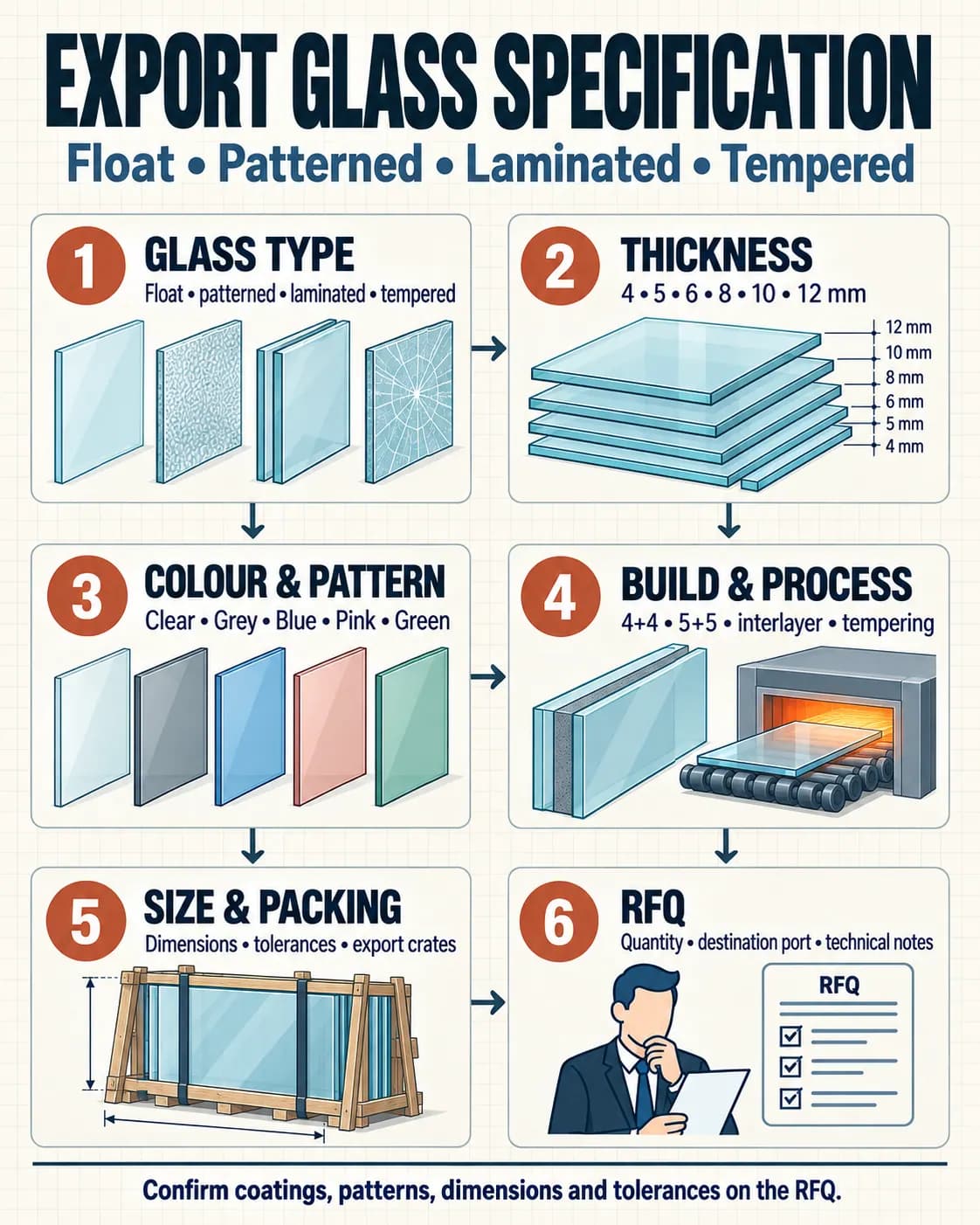
Do not combine different thicknesses, colors, sizes, or constructions under one general description. Build each line in this order: Glass family · appearance or coating · thickness or build · width × length · processing · quantity · packing · destination · Incoterm. Example: Clear float glass · 6mm · 2250 × 3210mm · 1 × 20ft container · export wooden crates · CIF [named destination port]. Use examples only as a formatting guide; confirm dimensions and availability for the actual order.
2. Write dimensions unambiguously
Glass inquiries often become unclear because dimensions are written without units or with inconsistent width and length order. Use millimetres for sheet or panel dimensions; a consistent width × length order; full numbers rather than abbreviated centimetres; sheet count and square metres where possible; container or truck quantity as an additional logistics measure—not the only quantity. Write 2250 × 3210mm rather than 225 × 321, unless centimetres are explicitly stated. For processed glass, provide a cutting schedule listing every panel size, quantity, and required operation. Attach drawings for irregular shapes, holes, notches, or cut-outs.
3. Float glass
Our current catalog lists float-glass thicknesses of 4mm, 5mm, 6mm, 8mm, 10mm, 12mm. Catalog colors include Clear, Grey, Blue, Pink, Green. These entries describe the catalog range. They do not mean that every thickness, color, and sheet-size combination is always in stock. For float glass, state: clear, tinted, or another body color; exact thickness; exact sheet dimensions; required sheet count, square metres, or container quantity; intended downstream use; required quality standard or defect limits; whether the glass will be tempered, laminated, mirrored, coated, or used in insulating-glass units; packing method; destination and Incoterm.
Clear, super-clear, and ultra-clear
Do not use “clear,” “super-clear,” “ultra-clear,” and “low-iron” as interchangeable terms. If optical performance matters, request technical values or an approved sample such as visible-light transmission, iron content where declared, color appearance, edge color, glass composition or product data sheet, and suitability for the intended processing. A commercial name alone may not establish the performance required by the project.
Tinted and colored float glass
State whether the required color is body-tinted glass or a coated product. Grey, bronze or brown, blue, green, black, and other market names may be interpreted differently by different suppliers. Confirm exact color name; reference sample or agreed photograph; thickness; sheet size; acceptable color variation; required light or solar performance if relevant; whether different production batches may be mixed. Color availability can depend on the current production campaign—ask what is in stock, what is being produced now, and when the next required color run is expected.
4. Patterned glass
Our catalog references patterns such as Karatachi, Windy, Sandy, Flora, Delta. Pattern names may vary by factory or market. A name alone may not identify the exact texture. Specify pattern name; clear or colored glass; thickness; sheet dimensions; pattern orientation if relevant; smooth-side and patterned-side requirements; intended application; quantity; required sample or close-up image; packing method. If the product must match an existing installation, send a physical sample or detailed reference image and confirm the match before production.
5. Wired glass
Treat wired glass as a separate product from standard patterned glass. State clear, bronze, or another color; pattern or surface texture; nominal thickness; sheet dimensions; wire-mesh type and arrangement; required fire, safety, or building classification if any; applicable standard and supporting evidence; intended application; quantity and packing. Do not assume that the presence of wire establishes a fire-resistance or safety classification. Wired-glass availability may follow a production sequence—confirm current stock and the next production run rather than relying on a general catalog listing.
6. Laminated glass
Our catalog lists common constructions such as 4+4 and 5+5, with custom builds available by confirmation. A build such as “5+5 laminated” identifies the glass plies but does not fully specify the product. State: thickness of each glass ply; annealed, heat-treated, or tempered construction; clear, tinted, reflective, patterned, or other glass type; interlayer material, thickness, and color; total panel dimensions; edge finish; holes, cut-outs, notches, or shaping; coating position where applicable; required safety or performance standard; quantity in pieces and square metres; packing method. Example: 5mm tempered clear + 1.14mm clear PVB + 5mm tempered clear · polished edges · dimensions by attached panel schedule is more useful than “5+5 laminated glass.”
Decimal laminated descriptions
Descriptions such as 6.38mm, 8.38mm, 10.76mm, or 12.76mm may be used commercially to indicate particular glass and interlayer combinations. Do not infer the construction from the total number alone. Ask the supplier to state individual ply thicknesses; interlayer material and thickness; whether the plies are annealed or tempered; actual nominal total thickness; applicable tolerances.
7. Tempered glass
The catalog describes 4–12mm as a typical tempered-glass range. Exact dimensions, processing limits, and production capability are confirmed per order. Specify base glass type; color or coating; thickness; finished dimensions; edgework; holes and locations; cut-outs or notches; corner treatment; required tempering or heat-treatment standard; required permanent marking; flatness, bow, or roller-wave limits where important; heat-soak testing if required; quantity and packing. All cutting, drilling, edgework, and shaping must be defined before tempering. For repetitive panels, provide a numbered schedule and approved drawing for each panel type.
8. Tempered laminated glass
When both processes are required, state them explicitly. “Laminated” does not automatically mean “tempered laminated.” A complete line should identify tempered status of each ply; ply thicknesses; interlayer type and thickness; finished panel size; edge finish; holes and cut-outs; coating or printing; required quality and safety standard; quantity by panel reference; packing by panel or project zone. For project orders, request final cutting optimization and confirmation of producible dimensions before approving the pro forma.
9. Mirror glass
Mirror specifications should identify the coating system rather than using “mirror” as the full product description. Confirm silver-coated or aluminum-coated mirror; single- or double-coated construction where relevant; clear, bronze, grey, blue, or another base-glass color; thickness; sheet dimensions; backing-paint or protective-coating requirements; edge finish; moisture or corrosion-resistance requirements; intended use; required quality criteria; packing. Silver and aluminum mirrors are different products. Do not accept an undocumented substitution because their front appearance seems similar in a photograph. For colored mirror, request a sample or agreed color reference before confirming a container order.
10. Reflective and coated glass
Reflective glass should not be specified only by color. State base-glass type and color; reflective-coating color; thickness; sheet dimensions; coating type where specified; coated-face orientation; intended facade, interior, or solar-control use; required visible-light and solar-performance values; processing requirements; whether tempering or laminating is required; edge-deletion or handling requirements where applicable; quantity and packing. Tinted float glass, reflective glass, and Low-E glass serve different purposes. Do not allow one to be substituted for another without technical approval. If the catalog does not contain enough coating data, treat the request as project-specific and ask for a technical data sheet, sample, and written factory confirmation.
11. Ultra-clear and low-iron glass
For ultra-clear or low-iron glass, provide required thickness; sheet dimensions; intended application; required visible-light transmission; edge-color expectation; whether tempering, laminating, coating, or printing is required; required standard or approved equivalent; quantity and packing. If “super-clear” is offered, ask whether it is the same product as the specified low-iron or ultra-clear glass. Compare technical data—not only product names.
12. Solar glass
For solar or photovoltaic applications, state module or collector application; glass thickness; dimensions; low-iron requirement; smooth or textured surface; coating requirement; required transmission; heat-treatment requirement; edgework; strength and quality standard; quantity and packing; required product and test documentation. “Solar glass” is a use category, not a complete technical specification.
13. Define quality instead of writing “Grade A”
Terms such as “Grade A,” “export quality,” and “best quality” are not measurable unless the parties define them. Specify or agree on applicable product standard; thickness and dimensional tolerances; squareness; surface quality; scratch limits; bubble, inclusion, or impurity limits; optical distortion; edge defects; color tolerance; coating uniformity; tempering distortion; laminated-glass bubbles, delamination, and interlayer quality; inspection distance and lighting; sampling method; accepted rejection criteria. Where no formal standard is specified, attach an approved quality schedule with photographs or limit samples.
14. Confirm size and production availability
Do not assume that a thickness listed in the catalog is available in every size and color. Ask which sizes are in stock now; which thickness is currently on the production line; which color or coating is being produced; when the next required production campaign is; whether the factory can cut jumbo or standard sheets to the required size; whether the requested size suits the required processing; what minimum quantity applies to a dedicated production run; whether stock from different batches may be mixed; how long the confirmed stock will be held. Reconfirm current stock before issuing or paying against the pro forma.
15. Confirm MOQ and lead time
Many public glass schedules list MOQ approximately one 20ft container and indicative production lead time approximately 7–15 days. These are catalog references. Final MOQ and timing depend on glass family, thickness, color or production campaign, sheet dimensions, processing, stock availability, packing method, mixed-load feasibility, and factory schedule. Ask what starts the lead-time calculation: payment, final drawing approval, order confirmation, or another agreed event. Production lead time, packing time, customs preparation, and transit time should be stated separately.
16. State quantity in more than one way
For a complete RFQ, provide quantity as applicable in sheets or panels; square metres; crates, racks, or packages; containers or trucks; approximate tonnes. The final commercial quantity should be reconciled against the packing and load plan. If different products will share a container, list the required quantity for every line. Do not assume the factory can create a mixed load safely or within the vehicle’s payload.
17. Specify the packing
For export glass, confirm wooden crates, stillages, racks, or approved bulk packing; upright loading requirement; sheets per package; equalized or otherwise approved package loading; number of packages per container or truck; edge and corner protection; separators; base support; bracing and lashing; net and gross weight; total loaded weight; package dimensions; loading photos or inspection. Packing price and included supports should appear in the quotation or pro forma. A container quantity should not be maximized at the expense of safe package construction, vehicle limits, or consistent support.
18. Request only relevant evidence
Depending on the product and destination, the RFQ may request technical data sheet; product test report; certificate of analysis; tempering or laminated-glass test evidence; quality certificate; certificate of origin; packing list; inspection report; destination-specific certificate. Ask which factory, product, standard, and validity period each document covers. Do not assume a certificate exists because a product page, photograph, stamp, or previous shipment refers to it. Required documents must be confirmed for the actual order.
19. Define inspection before production or loading
For higher-risk or processed orders, agree on inspection scope before production. Inspection may include product identification; thickness and dimensions; color or pattern; glass construction; edgework and holes; visible quality; quantity; package construction; sheets per package; weights; loading orientation; bracing and lashing; seal number; final shipment documents. An approved sample helps with appearance, but it does not replace inspection of the production goods.
20. Example RFQ lines
The following are format examples—not statements of current availability.
- Float: Clear float glass · 6mm · 2250 × 3210mm · [sheet or m² quantity] · one 20ft container · export wooden crates · FOB [named port]
- Patterned: Clear Delta patterned glass · 4mm · [width × length]mm · pattern orientation confirmed by sample · [quantity] · wooden crates · EXW [named factory]
- Laminated: Tempered laminated glass · 5mm clear tempered + 1.14mm clear PVB + 5mm clear tempered · polished edges · panel sizes by attached schedule · [total pieces and m²]
- Mirror: Double-coated aluminum mirror · clear base glass · 4mm · [width × length]mm · [sheet quantity] · export wooden crates · CIF [named port]
- Reflective: Grey reflective glass · 5mm · coating specification and coated-face orientation to be confirmed · [width × length]mm · [quantity] · technical data sheet required
21. Minimum information to start an RFQ
At minimum, provide glass family; thickness or laminated build; color, pattern, coating, or mirror type; exact dimensions and units; quantity; required processing; preferred packing; destination; Incoterm. Adding intended use, quality criteria, document requirements, and inspection scope will produce a faster and more comparable quotation.
22. What happens after submission
Once submitted, your RFQ is reviewed by our team. Each line is checked for technical completeness before current pricing, stock, production, packing, and logistics are confirmed. Follow-up may be required to resolve ambiguous glass terminology; missing units; unconfirmed dimensions; color or coating availability; laminated build or interlayer details; tempering and processing requirements; mixed-container feasibility; packing and payload; required certificates or inspection. Submitting an RFQ does not reserve stock, schedule production, or guarantee a catalog price. The final specification and commercial terms are confirmed in the quotation or pro forma.
Catalog note: Public thicknesses, colors, builds, MOQs, lead times, and price bands are orientation data. Confirm every line against current factory capability before placing an order.